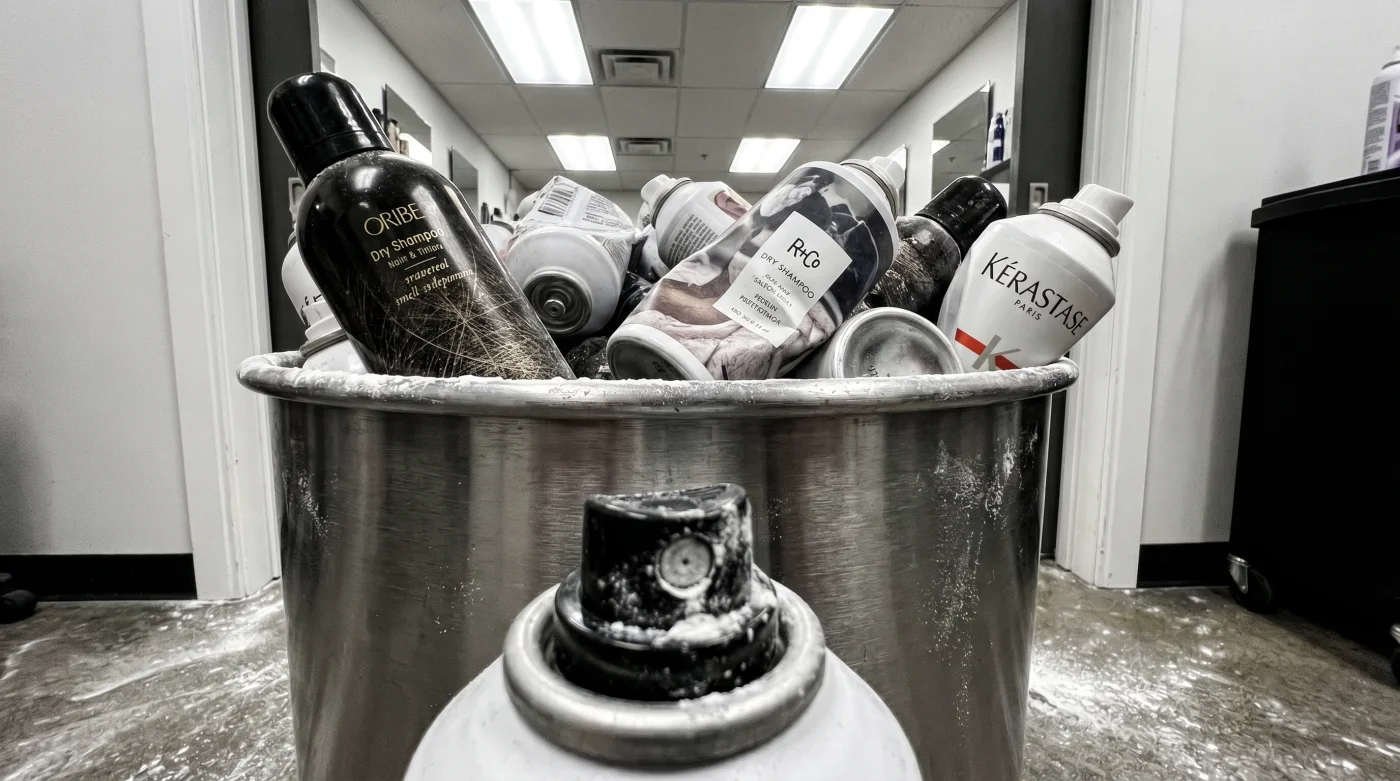
You know the sound. That sharp, icy hiss echoing against the bathroom tiles at 7:15 on a damp Tuesday morning. It smells faintly of synthetic cherry blossom and panicked rushing. For years, you have relied on that powdery blast to buy yourself an extra twenty minutes in bed, trusting the white mist to absorb the evidence of yesterday’s gym session before you dash for the Central line. It is a ritual as ingrained as boiling the kettle.
It feels like the ultimate modern convenience. A magic trick in an aluminium can that turns lank roots into passable volume. You spray, you tousle, you walk out the door. But if you wander into the hushed, minimalist spaces of Mayfair or Marylebone’s top-tier hair clinics this week, you will notice something peculiar. The air is clear. The familiar aerosol cans have vanished from the pristine retail shelves, replaced by empty space and whispered conversations between stylists.
There is a silent exodus happening in the professional hair world. What was once the unspoken hero of the busy morning routine is quietly being packed into cardboard boxes and returned to distributors overnight. High-end salons are quietly refusing to stock the very products that once drove their retail margins, choosing reputation over easy sales.
The convenience you depend on is hiding a microscopic trace that the industry can no longer ignore. Think of your scalp not as a lifeless surface, but as a densely woven, highly absorbent living sponge. When you spray a traditional aerosol refresher, you are not just coating the hair shafts; you are pressing a chemical fog directly into your living skin.
The Phantom Scent and The Silent Trace
Independent laboratory testing has recently shaken the foundations of the beauty industry, contradicting everything we assumed about everyday aerosol refreshers. The invisible propellant used to blast that starch onto your roots—usually a mixture of butane and propane—often carries a silent passenger: benzene. This isn’t a deliberate cosmetic ingredient, but a manufacturing impurity born from the refining process.
The tests revealed a troubling reality about our morning habits. These elevated traces of chemical compounds don’t just dissipate into the morning air as you brush out the white cast. They settle. They sit on the warm micro-climate of your scalp for days, trapped beneath the very sebum and sweat you were trying to disguise, quietly absorbing into the barrier layer of your skin.
Suddenly, the quick fix feels more like a slow trap. You are sacrificing the fundamental health of your hair follicles for a mere illusion of cleanliness. By trading the daily wash for a pressurised chemical mask, you are slowly suffocating the delicate root system, creating an environment where healthy hair simply cannot thrive.
Clara Bowden, a 42-year-old session stylist and trichology consultant based in Soho, noticed the physical toll long before the lab reports hit the trade papers. “I was seeing an epidemic of inflamed, weeping scalps and thinning crowns in women who seemingly did everything right,” she explains. “They were buying expensive serums, but spraying industrial propellants on top of them every morning.”
Clara began a controversial practice in her clinic: she started confiscating her clients’ aerosol refreshers. Instead, she prescribed a return to old-school mechanical brushing and raw, non-aerosol powders. The transformation was startling. Within a month, her clients’ hair didn’t just recover from the chemical burden; it found a natural, buoyant movement that no canned spray could ever replicate. The roots began to breathe again.
Which Route Fits Your Morning?
Giving up the morning hiss requires a slight recalibration of your routine, but it does not mean waking up at dawn to wash your hair every day. The alternative you choose depends entirely on your natural hair rhythm and the demands of your week.
- UK regulators quietly drafting bans on three trending chemical sunscreen filters
- Swallowing marine collagen without this specific fat makes it entirely useless
- Why your daily SPF 50 moisturiser is leaving you completely unprotected by noon
- The acidic kitchen staple secretly outperforming luxury clarifying shampoos
- Professional makeup artists never apply concealer directly to under-eye bags
- Mixing Vitamin C with this common foundation destroys your skin barrier in hours
- The specific jawline scrape that permanently replaces expensive dermal fillers
- Dermatologists confirm women over 40 should stop applying retinol right before bed
- Women over 50 are applying hyaluronic acid on dry skin and accelerating wrinkles
For the Purist: If your roots turn glassy by mid-afternoon, you need genuine absorption without the toxic propellants. Loose, finely milled powders—like pure arrowroot mixed with a pinch of cocoa powder for brunettes—applied with a dense makeup brush offer exact control. You paint it onto the scalp like a delicate watercolour, letting the natural starches drink up the excess oils without forming a suffocating paste over the follicle.
For the Active Commuter: If you cycle to work or hit a morning Pilates class, applying powder to damp sweat will simply create a murky residue. Your alternative isn’t a product, but a technique. Rinsing your hair with lukewarm water alone, followed by a targeted blow-dry at the roots using a cool setting, resets the hair’s memory. It removes the salt and physical sweat without stripping the protective lipid layer that keeps your lengths hydrated.
For the Frequent Heat-Styler: If you rely on tongs and straighteners, your ends are likely parched while your roots get oily. You need to redistribute rather than absorb. A high-quality boar bristle brush is your best tool. Brushing firmly from the nape of the neck upwards pulls the heavy sebum away from the scalp and down to the dry ends, naturally conditioning the hair while instantly making the roots appear cleaner.
Mindful Application
Removing aerosol refreshers from your bathroom cabinet forces a healthier relationship with your hair. You move from frantic spraying to intentional care. It is about working with your body’s natural oil production, rather than engaging in a daily chemical war against it.
The scalp needs oxygen, and the hair shaft needs those natural oils to stay resilient against the damp, cold British weather. By shifting to manual, mindful application methods, you protect your physical health while actually improving the aesthetic quality of your hair.
- The Evening Prep: Section your hair before bed and lightly dust a non-aerosol tapioca powder onto the roots. Moving while you sleep works the powder in invisibly, meaning you wake up with volume rather than a powdery residue.
- The Boar Bristle Sweep: Spend three minutes each night brushing from root to tip. This mechanical action stimulates blood flow to the follicle and clears away dead skin cells that cause dullness.
- The Damp Towel Trick: In the morning, wrap a warm, slightly damp muslin cloth around your fingers and massage the scalp gently to lift away old product, overnight sweat, and impurities.
Your Tactical Toolkit requires almost no electricity, yet it delivers professional results. Invest in a pure boar bristle brush, a glass jar of finely milled non-aerosol powder (arrowroot or kaolin clay base), and a dense kabuki brush for targeted application. Keep the water temperature tepid when you do eventually wash, as scalding showers will trigger the scalp to overproduce oil in a panic response.
This mindful approach takes exactly the same amount of time as vigorously shaking a can and attempting to rub out a white powdery cast, but it leaves your scalp perfectly clean, calm, and free from industrial residues.
The Bigger Picture
Letting go of that familiar aluminium can might feel like losing a safety net. We have been conditioned to believe that speed equates to efficiency, that a three-second blast of synthetic starch is a fair trade for a proper, thoughtful routine. But there is a quiet relief in stepping away from the chemical fog.
When you stop treating your hair as a nuisance to be masked and start treating your scalp as living tissue to be tended, the panic of the morning rush begins to fade. You are no longer coating your roots in invisible, lingering traces of volatile by-products just to save ten minutes.
Instead, you are fostering a foundation that grows stronger, thicker, and naturally balanced with each passing week. It is a small, almost invisible shift in your bathroom routine, but it reclaims a fragment of genuine, long-term wellbeing from the jaws of modern, toxic convenience.
“True volume comes from a breathing, unburdened scalp, not from cementing your follicles beneath a layer of propelled synthetic starch and trapped impurities.”
| Approach | The Detail | Added Value for You |
|---|---|---|
| Aerosol Dry Shampoo | Propels starch via butane/isobutane, risking benzene contamination. | Immediate speed, but clogs follicles and introduces lingering toxic traces. |
| Loose Powder & Kabuki | Applying arrowroot or clay directly to the root with a soft makeup brush. | Zero chemical propellants; exact application means no white cast or buildup. |
| Mechanical Brushing | Using a natural boar bristle brush nightly to distribute natural sebum. | Naturally conditions dry ends while keeping roots visibly clean and buoyant. |
Common Scalp & Refreshing Questions
Will loose powder block my pores like aerosols do?
No. Without the chemical propellants and synthetic silicones, natural milled powders wash away effortlessly with mild water, leaving the follicle completely clear.How long does the transition period last?
If you have relied on aerosols daily, your scalp may overproduce oil for about two weeks as it recalibrates. Brushing through this phase is key to balancing the natural lipids.Can I use baby powder instead?
It is best avoided. Many commercial baby powders contain talc or heavy artificial fragrances that can irritate adult hair follicles. Stick to food-grade arrowroot or pure cosmetic clays.Does the water-only rinse actually clean sweat?
Yes. Sweat is water-soluble. A thorough lukewarm rinse physically removes the salt and perspiration without needing harsh detergents to strip the hair.How do I clean my boar bristle brush?
Once a week, remove the loose hair, then gently wash the bristles in warm water with a single drop of mild shampoo. Lay it face down on a towel to air dry completely.