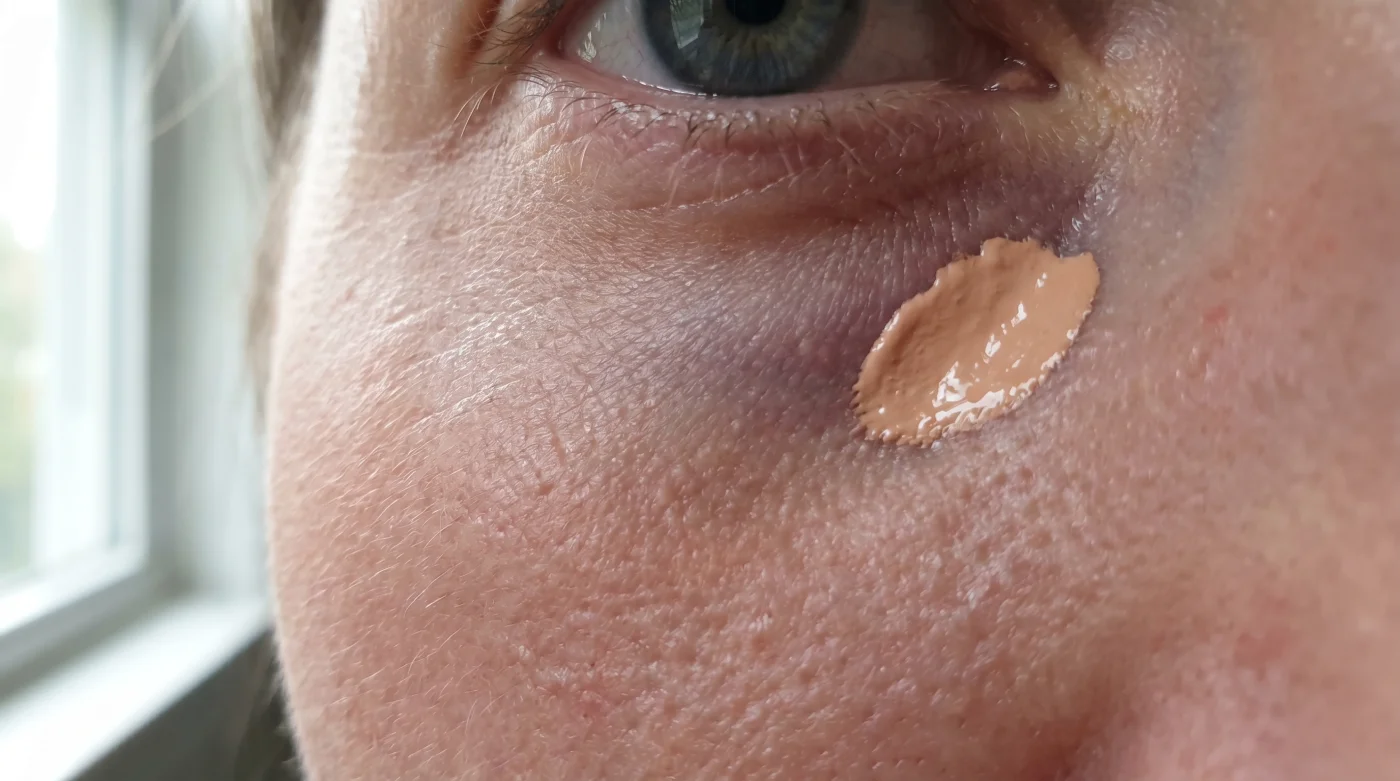
It happens in the harsh, blue-tinged light of a British winter morning. You stand before the bathroom mirror, unscrewing the lid of your favourite liquid cover-up, and proceed to drag a thick, heavy triangle directly over the darkest, most exhausted part of your under-eye. It is a desperate, reflexive habit. You pat it down with a damp sponge, hoping to erase the physical evidence of a broken night’s sleep.
Yet, an hour later, the mirror betrays you. The skin looks heavier, the fine lines appear exaggerated, and the dark crescent somehow seems more pronounced, sitting beneath a layer of chalky pigment. This aggressive masking technique is the single greatest error we commit against our own faces, born from the simple misunderstanding of how light interacts with skin.
Backstage in the quiet corners of fashion week, or in the serene, brightly lit studios of editorial photoshoots, you will notice a distinct absence of this frantic smearing. Professionals do not treat the face as a wall to be plastered. They approach the delicate skin beneath the lash line with the precision of a jeweller examining a gem.
The secret lies in a counter-intuitive restraint. By refusing to coat the entire area, and instead targeting an almost invisible border, the face changes. By manipulating the light directly rather than burying the texture, you create a sudden, natural lift that requires a fraction of the product you currently consume.
The Physics of the Shadow Line
To understand why your current method fails, we must look at the architecture of the eye. A dark circle is rarely just a patch of pigmented skin; it is a structural trough. When you suffer from a lack of sleep or simply the natural thinning of skin as you age, the orbital bone creates a physical indentation.
Imagine shining a torch across a dented skirting board. If you paint the entire dent with bright white paint, the dent remains completely visible because the shadow still falls across it. You must paint the shadow itself, placing the lightest pigment exclusively on the deepest part of the crease where the darkness pools.
When you apply a thick layer of product directly over the entire under-eye bag, you bring both the puffy area and the recessed area forward equally. The contrast remains identical. The bag is still there; it is just a lighter shade of beige.
The perspective shift happens the moment you restrict your application to the exact millimetre where the shadow falls. Placing it exclusively there forces the recessed skin to visually spring forward, sitting flush with the rest of your cheekbone. It is an optical illusion that lifts the entire face instantly.
The Wisdom of the Editorial Chair
Clara Davies, a forty-two-year-old makeup artist working in Manchester’s television industry, spends her mornings undoing the habits of her presenters. They sit in her chair, clutching their lattes, apologising for their tired eyes, and expecting her to reach for a heavy, full-coverage spackle to hide their exhaustion.
- Mixing Vitamin C with this common foundation destroys your skin barrier in hours
- The specific jawline scrape that permanently replaces expensive dermal fillers
- Dermatologists confirm women over 40 should stop applying retinol right before bed
- Women over 50 are applying hyaluronic acid on dry skin and accelerating wrinkles
Instead, she reaches for a multi-tonal concealer palette and a brush the size of a match head. She explains to her clients that heavy layers in the hollows of the eyes act like a weighted blanket, pulling the delicate tissue downward as the hours tick by. True coverage requires true optical trickery, blending a colour that matches the cheek precisely on the boundary line of the shadow, rather than suffocating the skin above it.
Tailoring the Canvas: The Adjustment Layers
Not all under-eye concerns are built the same, which is why a single tube of liquid rarely solves the problem. Understanding the specific topography of your face dictates how you wield your brush, ensuring you do not exacerbate the very issue you wish to hide.
For the Hollowed Contour
If your primary concern is a deep recession rather than puffiness, your focus must be purely on corrective warmth. The skin here is thin, often revealing the purple muscle beneath. You need a peach-toned cream from your concealer palette. Tap the smallest speck of this warmth directly into the deepest part of the hollow, neutralising the bruise-like hue before applying a skin-matching shade just below it.
For the Puffy Pillow
A raised bag catches the light on top and casts a dark shadow underneath. If you put bright product on the puffy part, you highlight the swelling. Instead, you must match the puffy area to your exact foundation shade, and only use a brighter hue in the crescent-shaped trench sitting below the bag.
For the Fine-Line Web
If your skin resembles crushed silk, liquid formulas will pool in the crevices within twenty minutes. You require a drier, pot-based formula. Warm it thoroughly between your ring fingers until the cream should tremble and melt, pressing it gently into the shadow line. The warmth binds the pigment naturally to the skin’s oils, preventing it from migrating into the lines.
The Micro-Placement Technique
Mastering this application requires abandoning the sponge for a moment. You are not blending a smoothie; you are delicately placing light. Prepare your skin with a lightweight, water-based eye serum, allowing it to sink in entirely. The skin should feel like bare, cool glass, not a slippery surface.
The deliberate, quiet application process turns a frustrating morning chore into a mindful ritual. Follow these specific parameters to execute the shadow-line lift:
- The Tool: Acquire a tiny, stiff, synthetic brush—the sort usually reserved for applying lipstick or detailing eyeliner.
- The Mix: From your concealer palette, scrape a pinhead-sized amount of product onto the back of your hand. Swirl the brush until the bristles are thinly coated but not gloopy.
- The Placement: Tilt your chin down while looking straight into the mirror. This exaggerates the shadow. Paint a hair-thin line strictly inside the darkest part of the crescent.
- The Marination: Leave the product untouched for sixty seconds. Letting the cream dry down slightly increases its grip and opacity.
- The Melt: Use the pad of your ring finger to press—never rub—the edges of the line into the surrounding skin. It should feel like breathing through a pillow, using only the lightest pressure to diffuse the border.
The Tactical Toolkit requires precision. These small adjustments ensure the pigment behaves exactly as intended, fusing with your complexion rather than sitting awkwardly on top of it.
- Ideal product temperature: Skin-warmed (roughly 37 degrees Celsius).
- Waiting period before blending: 45 to 60 seconds.
- Setting agent: A microscopic dusting of finely milled translucent powder, applied only with a small, fluffy eyeshadow brush.
When you cease fighting your face with thick layers of pigment, the anxiety of the morning routine dissipates. You are no longer trying to obscure a perceived flaw behind a mask of heavy beige. You are simply softening the edges of your natural architecture.
Reclaiming the Morning Face
Embracing this minimalist approach grants you back your time and preserves the living, breathing texture of your skin. A face that moves, creases, and catches the light naturally is inherently more beautiful than a perfectly flat, matte illusion.
Next time the grey light of morning hits your bathroom mirror, resist the urge to paint away the night before. Look closely at the shadows, pick up the smallest brush you own, and manipulate the morning light. The lift is instant, but the shift in how you view your own skin is permanent.
Concealer is not a plaster for your exhaustion; it is a lighting director for your bone structure. Treat it with respect, and your face will rise to meet the day.
| Key Point | Detail | Added Value for the Reader |
|---|---|---|
| Application Zone | Target only the shadow border, not the puffiness. | Instantly lifts the cheekbone visually. |
| Product Volume | Pinhead amount applied with a stiff brush. | Prevents creasing and settling into fine lines. |
| Marination Time | Allow product to rest for 60 seconds. | Increases coverage without needing extra layers. |
Frequently Asked Questions
Can I use a liquid wand instead of a concealer palette?
Yes, but a palette allows for bespoke colour mixing. Liquids often dry too quickly for the micro-placement technique, whereas a cream palette offers controlled, buildable opacity.How do I stop the product from settling into wrinkles?
By keeping the product entirely away from the lash line. Focus solely on the shadow trough lower down the cheek, bypassing the high-movement areas where lines form.Do I need to set the shadow line with powder?
Only if your skin is particularly oily. If you do, use an incredibly light dusting on a fluffy brush. Heavy powder will undo the reflective lift of the cream.What if my dark circles are severely pigmented?
Address the colour first with a peach corrector from your palette, tapping it strictly into the darkest zone before applying your skin-toned shade.How often should I clean the micro-brush?
After every single use. A stiff brush quickly becomes clogged and rigid, which will pull at the delicate under-eye tissue rather than gliding over it.