You stand in the bathroom mirror in the quiet grey light of a Tuesday morning. Your fingers instinctively press into the soft flesh beneath your chin, pulling the skin back towards your ears to mimic the tightness of a decade ago. It is a universal, slightly melancholic morning ritual, usually followed by the sinking realisation that gravity feels increasingly heavy.
The modern temptation is to book a four-hundred-pound appointment at a discreet clinic. A needle, a syringe of hyaluronic gel, and a promise of restored architecture. But introducing artificial volume into delicate facial tissue often creates an unexpected problem over time. Instead of lifting, the face becomes a reservoir, holding onto fluid and creating an artificial weight dragging it down rather than creating genuine definition.
There is a quieter, infinitely cheaper alternative sitting right there on your vanity table. A smooth piece of carved rose quartz or jade. The gua sha stone is frequently dismissed as a trendy, superficial accessory for temporary smoothing, but when handled with the precision of a clinician, it ceases to be a simple massage tool and becomes a structural activator.
The Architecture of Stagnation
Most people drag the stone across their face like a squeegee, hoping to aggressively iron out wrinkles. That is a fundamental misunderstanding of human anatomy. Your face is not a crumpled piece of linen; it is a complex, breathing network of fascia, muscle, and lymphatic fluid that responds poorly to blunt force.
When you rely heavily on clinical injectables for a lost jawline, you are ignoring the root cause. You are filling a sagging tent with water instead of tightening the ropes, merely treating a collapsed scaffolding symptom rather than rebuilding the foundation itself.
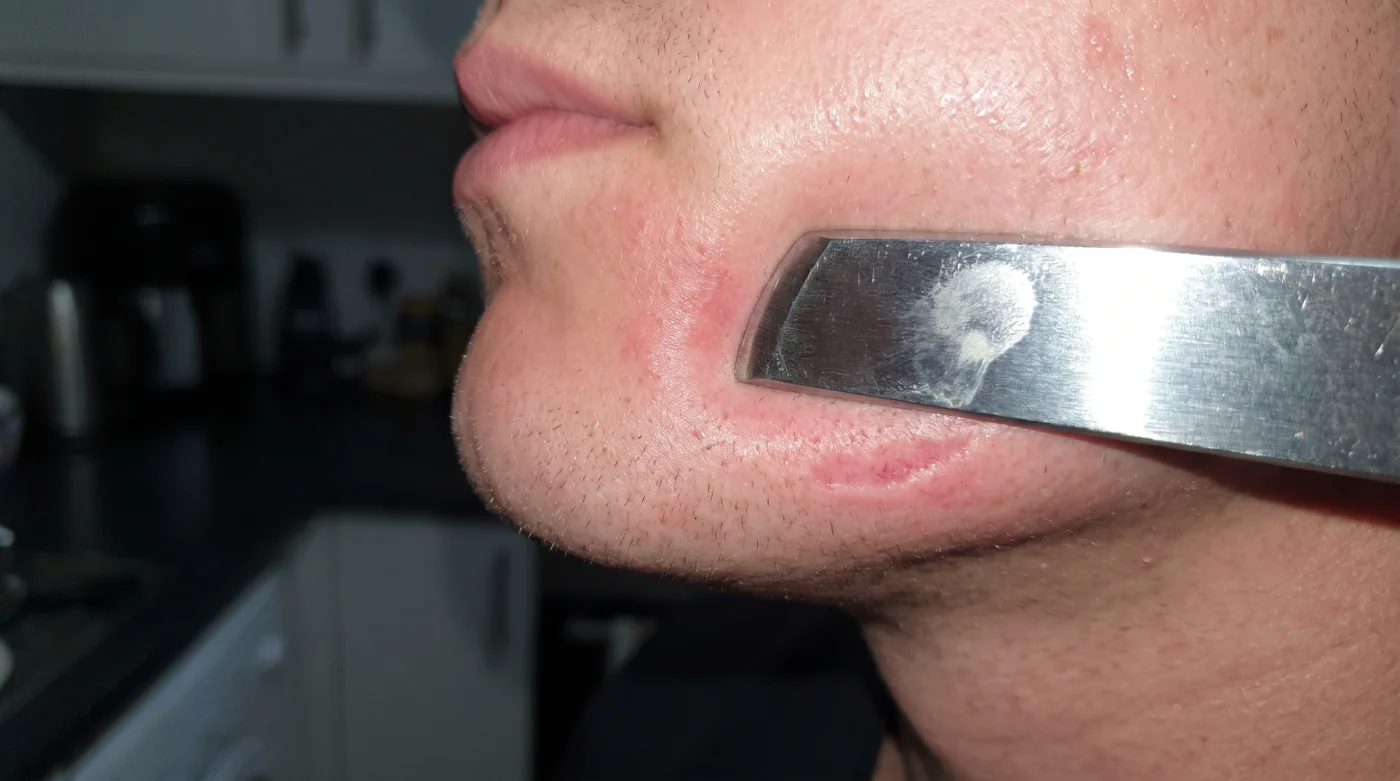
By altering the angle of the gua sha stone to exactly 15 degrees against the jawline, you are not just draining stagnant lymph. You are creating micro-frictions beneath the epidermis. This specific scraping motion acts much like aerating compacted soil in a garden.
This deliberate, mechanical friction along the bone line sends a signal to your fibroblasts. Rather than relying on a synthetic sponge of gel, this precise manipulation stimulates localised collagen clustering, forcing the body to lay down new structural fibres exactly where they are needed most.
Consider the quiet professional shift made by Clara Bowden, a 52-year-old aesthetic practitioner based in a private mews just off Harley Street. For fifteen years, Clara was celebrated for her undetectable filler work, carefully injecting millilitres of volume into the lower faces of London professionals. But three years ago, she stopped offering the treatment entirely.
She noticed that long-term filler did not lift; it spread. It acted like an internal sponge, drawing water and creating a heavy, pillowy softness that blurred the very bone structure it was meant to define. Today, she exclusively uses a dense piece of black obsidian on her clients, manually restoring native fluid dynamics and coercing the body into rebuilding its own structural integrity.
Adjustment Layers for Your Unique Architecture
Not all lower faces require the same mechanical pressure or identical pathways. The way you approach this structural manipulation depends entirely on how your specific facial architecture holds tension, fluid, and age.
For the Heavy Retainer. If you wake up with a jawline that feels thick and doughy, your primary issue is not a lack of collagen, but a surplus of trapped cellular waste. Your focus must be on draining the stagnant fluid reservoirs before attempting any deep structural friction. Spend your first two minutes lightly sweeping down the neck towards the collarbone to open the drainage pathways.
For the Tension Holder. If you find yourself clenching your teeth during the commute or holding your jaw rigid while reading emails, your masseter muscles are overworked and permanently contracted.
This chronic tightness pulls the lower face out of alignment, creating the illusion of jowls. You must use the notched edge of the stone directly over the jaw hinge, applying a firm, vibrating pressure to stop grinding down the structural ligaments and allow the muscle to finally lay flat.
The 15-Degree Collagen Scrape
Let us abandon the aggressive, fast-paced rubbing seen on morning television segments. This is a practice of deliberate, mindful resistance. You are communicating directly with your bone structure, and that requires absolute precision.
You must first apply a liberal layer of a high-slip facial oil—think pure squalane or a rich rosehip seed oil. The stone must glide effortlessly over the epidermis without ever dragging or anchoring the tissue in place, as stretching the surface skin is exactly what we are trying to avoid.
- The Angle: Hold the tool almost entirely flat against your skin, at roughly a 15-degree angle. Never hold it at 90 degrees; you are not slicing a cake.
- The Grip: Support your chin with your non-dominant hand. This provides the necessary counter-tension so the skin does not pull.
- The Pathway: Place the notch of the stone at the centre of your chin. Slowly, with the pressure of a coin resting on your skin, sweep along the jawline towards the base of the ear.
- The Anchor: Once you reach the ear, give the stone a tiny, deliberate wiggle. This stimulates the primary lymph nodes and signals the fluid to drain down the neck.
- The Frequency: Five sweeps per side. No more. Overworking the tissue creates inflammation, which leads to puffiness.
The Return to Your Own Bone Structure
We have been conditioned to view ageing as a sudden, terrifying hollowing out of the face that must be frantically stuffed with synthetic gels and costly injectables. But true facial ageing is often just a slow settling of fluids and a resting of dormant muscles.
Mastering this specific 15-degree scrape is about stepping off the endless, expensive treadmill of clinical top-ups. It is the quiet, daily act of reclaiming your own native architecture, relying on your body’s inherent ability to heal, tighten, and cluster collagen right where it counts. You are no longer masking the structural decline; you are actively reversing it with nothing more than cold stone and your own two hands.
“True facial definition is never found in a syringe; it is sculpted by clearing the stagnant water and waking up the bone.” — Clara Bowden, Aesthetic Practitioner
| Key Point | Detail | Added Value for the Reader |
|---|---|---|
| The 15-Degree Angle | Keep the stone almost flat against the skin, avoiding a harsh 90-degree scrape. | Prevents surface skin stretching while safely engaging the deeper fascia. |
| Counter-Tension | Always anchor the chin with your opposite hand before sweeping upwards. | Ensures the friction happens beneath the skin, stimulating collagen without causing wrinkles. |
| The Terminal Wiggle | A small vibrating motion at the base of the ear at the end of each stroke. | Actively opens the lymphatic drainage gate, reducing morning puffiness immediately. |
Frequently Asked Questions
Can a piece of stone really replace professional dermal fillers?
Yes, provided you are consistent. You are swapping instant, synthetic volume that degrades over time for gradual, natural structural strength that your body maintains itself.How long does it take to see the collagen clustering effect?
While the lymphatic drainage will instantly depuff your face in minutes, the genuine collagen clustering along the jawbone takes roughly six to eight weeks of daily practice to become visible.Should I keep my tool in the fridge?
It is highly recommended. The cold temperature constricts superficial blood vessels, immediately tightening the skin surface while you work on the deeper structural layers.Will this stretch my skin and cause more sagging?
Only if you skip the facial oil or hold the stone at a steep, aggressive angle. With high slip and a flat 15-degree angle, you are moving the muscle beneath, not the skin on top.What if my jawline feels bruised after doing this?
You are pressing far too hard. The pressure should be firm but never painful. Think of smoothing out a piece of silk laid over a wooden table; you want to feel the table, not tear the silk.